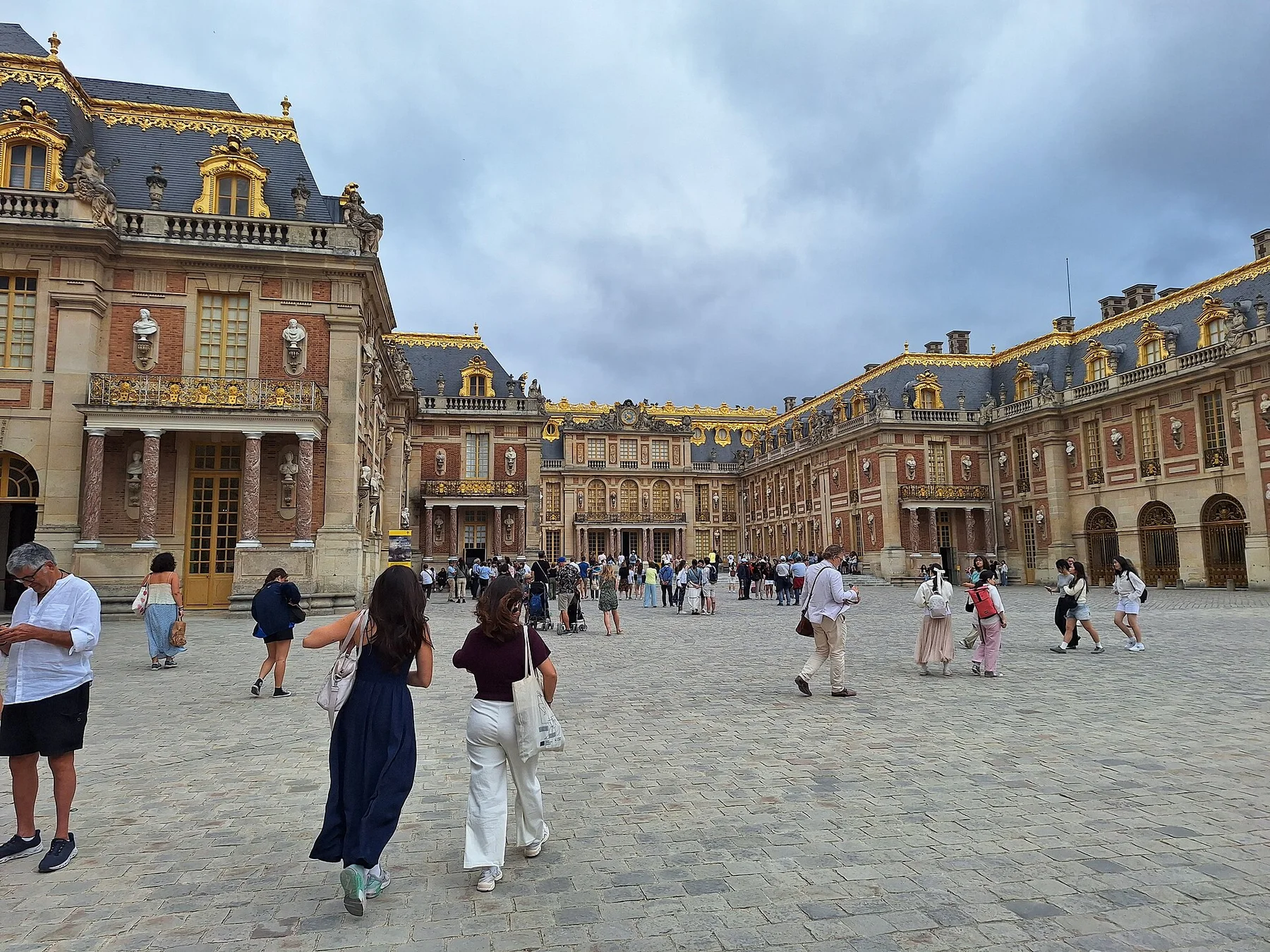
Four excursions outside the city walls — each its own trip, none walkable to the next. Versailles is the full day; the others are half days you can slot in around the central routes.
Palace of Versailles Gardens of Versailles Basilique Saint-Denis Bois de Boulogne
Audio Preview
Introduction to Beyond the Périphérique
Route Overview
Stops on this Tour (18)
Palace of Versailles – Royal Apartments
Look first at the gilded doorframes and the succession of rooms opening through one another. Inside the Royal Apartments of Versailles, those thresholds once carried political meaning. Each doorway brought a courtier closer to the monarch, and each room could narrow the circle of people allowed to proceed. Under Louis XIV, daily life here became part of government itself. Power could be expressed through something as simple as permission to enter the next room.
Versailles – Royal Opera (Opéra Royal)
Look up and follow the tiers as they curve around the Royal Opera. The auditorium forms an unusual oval, with open French-style boxes and, high above, a colonnade that makes the upper level feel unexpectedly light. Designed by Ange-Jacques Gabriel and inaugurated in 1770, this was one of the most adaptable court theatres of its age. Its elegance conceals an extraordinary practical idea. The room was designed to change from theatre to ballroom or banqueting hall when royal ceremony demanded it.
Versailles – King's Grand Apartments
Pause for a moment at the start of the King's Grand Apartments and look through the aligned doorways. Seven richly decorated rooms unfold in sequence, with marble walls, gilded ornament and painted ceilings pulling your eye from one space into the next. This was an apartment of parade, created for the official life of the sovereign rather than ordinary domestic privacy. During the reign of Louis XIV, it was also opened for court gatherings several evenings each week. Here, royal power was organized room by room, and the order in which people moved through these spaces was part of the experience.
Versailles – Hall of Mirrors
Look first at the light. See how it crosses from the tall windows to the glass opposite. You are standing in the Hall of Mirrors, where seventeen windows face seventeen mirrored arcades made from 357 individual mirrors. The reflections seem to open another row of windows inside the wall, doubling the apparent depth and brightness of the gallery. Across roughly 73 metres, glass, marble, gilding, and painted vaulting repeat in a powerful rhythm. This room matters because its beauty was designed to make French craftsmanship and royal power visible at the same time.
Versailles Gardens – Latona Fountain
The most unsettling thing about Latona Fountain is how beautiful its punishment looks. You are standing beside one of the central anchors of the gardens of Versailles, where pale marble rises above gilded lead figures and a story of divine revenge is built into the landscape. Look first at Latona and her two children at the summit. Below them, human bodies are caught in the process of becoming something else. From a distance the composition looks calm and orderly. Up close, that order carries a warning.
Versailles Gardens – Apollo Fountain
Listen first for the splash, then look for the flashes of gold breaking through the water. Four horses thrust upward, Apollo rises behind them, and tritons and dolphins crowd the base of the group. The whole scene is designed to feel like one violent instant: sunrise bursting out of the sea. Now widen your view. On one side the gardens climb toward Latona and the château; on the other, the great perspective stretches away toward the Grand Canal. Apollo occupies the hinge between them.
Grand Trianon
Look at the pink marble on the low facade ahead of you. Notice how it catches the light. You are standing at the Grand Trianon, the palace built so Louis XIV could step away from the ceremony of his own court. Now look toward the open colonnade joining the two wings. Through its columns, courtyard and flowerbeds line up in one uninterrupted view. The roofs stay low, the wings spread sideways and the garden feels almost inside the palace.
Petit Trianon
The pale limestone cube in front of you is Petit Trianon, a royal residence small enough to feel like a house. Start with the tall windows and the roof concealed behind a stone balustrade. Let your eye follow that simple outline. Marie Antoinette made this building the centre of a domain shaped around her own choices. Here, a queen could decide who came through the door.
Hameau de la Reine
Look first across the water at the low thatched roofs gathered along the bank. A duck may call from somewhere near the path, making the scene feel even more convincingly rural. Yet Hameau de la Reine is not an old village absorbed into the royal estate. It was designed as a complete landscape for Marie Antoinette, with cottages, cultivated ground and a functioning farm. The apparent simplicity was carefully planned. For now, let the roofs and their reflections draw your eye around the lake.
Versailles – Orangerie
You are beside the Orangerie of Versailles, where royal architecture was built around living cargo. Look first at the long pale stone façade set directly below the palace terrace. In warm months, the lawns fill with rows of square planter boxes and Mediterranean trees. If the citrus is flowering, a faint, bittersweet perfume may reach you. In winter, that entire collection disappears behind the tall windows. This seasonal vanishing act explains everything you see here.
Basilique Saint-Denis – Nave and Royal Tombs
Listen to what the stone does to a footstep. The sound climbs. It thins out, then returns from nearly twenty-nine metres above you. You are standing in the nave of the Basilica of Saint-Denis, where two enormous stories occupy the same space. The twelfth-century chevet of this church helped define Gothic architecture, and Saint-Denis became the principal burial place of French royalty. Begin by following the slender stone shafts from the pavement toward the vaults, then notice how the tomb figures hold the human scale below.
Marché de Saint-Denis
Listen before you look up. Let the first wave of sound pass. Vendors call prices across the aisles, trolley wheels knock against the pavement, and the smells of herbs, fruit, fish, and hot food overlap in the air. You are standing at Marché de Saint-Denis, widely described as Île-de-France's largest public market and its most heavily attended, with around three hundred traders and crowds that can reach into the tens of thousands on a market day. Its reputation rests on choice, cultural range, and prices meant for everyday shopping. Look first at the stream of people passing between the iron hall and the outdoor stalls. That flow sets the rhythm of this stop.
Stade de France – Exterior
You are on the exterior concourse, with the entry gates in front of you. You may hear the hum of the A one motorway or the rattle of nearby trains. Now look up at the pale oval roof. It seems to hover above an arena built for about eighty thousand spectators. This is the Stade de France, created as France's national stadium for the nineteen ninety-eight World Cup. France won the final here, and a building only months old entered the country's shared memory.
Bois de Boulogne – Grande Cascade
Begin with the rock face. Today it may be dry, and the passage beneath it closed. As of September two thousand twenty six, the City of Paris lists the cascade as closed, so check the signs here in case access has changed. Dark sandstone ledges rise above the pool, cut with channels where water normally spreads and breaks into spray. This completely artificial formation is the dramatic focal point of this part of the Bois.
Bois de Boulogne – Pré Catelan
Listen to how the sound changes where the trees draw back and the ground opens into grass. Footsteps and voices carry differently across this broad lawn than beneath the dense canopy. This is the Pré Catelan, literally Catelan's meadow. It is a botanical garden folded into the Bois de Boulogne. The lawn is the first clue to its past. Before entertainment halls and fine dining, this was simply a pré, an open meadow. Around it, shaded paths and specimen trees form a green enclosure around the open air at its centre.
Jardin d'Acclimatation
Pause at the main entrance for a moment and let the scene settle. Beyond the gates, carousel music mingles with the sudden shrieks of riders. You are standing at the Jardin d'Acclimatation, a paid amusement park whose lawns once served a far darker form of entertainment. Near this entrance, look for the commemorative plaque before the bright machinery pulls your eye away. It records a history the present park does not immediately reveal: people were once displayed here for crowds. That collision between family pleasure and colonial memory is what makes this garden matter.
Fondation Louis Vuitton
The western tree line seems to have caught a glass ship. You are standing beside the Fondation Louis Vuitton, where twelve translucent sails rise above a white core and a shallow basin. Look first at the edges of the glass, because no two viewpoints make them line up in quite the same way. The building changes as clouds pass, reflections slide, and the trees break across its surface. Frank Gehry made the museum itself the first encounter with art.
Hippodrome de Longchamp – Exterior
You are beside Hippodrome de Longchamp, the historic home of major French flat racing and the stage of the Prix de l'Arc de Triomphe. Through the trees of the Bois, its layered grandstand comes into view above the turf. The terraces angle toward the finish line, creating the building's distinctive sloping silhouette. On a quiet day, the broad enclosures reveal the scale of the place. On race day, crowd noise and racing action focus every eye on the final seconds at the post.
Start this Journey
Download the Paris Audio Tour Guide Offline app to unlock the full audio guide, offline maps, and GPS navigation for this tour.