A day for the alternative Paris — the cabaret quarter that gave us Impressionism, the white basilica on the hill, the rugged 19th-arrondissement park, and the city's most famous cemetery. Métro line 2 stitches the day together.
Moulin Rouge Place du Tertre Sacré-Cœur Basilica Parc des Buttes-Chaumont Père-Lachaise Cemetery
Audio Preview
Introduction to Bohemia & Beyond
Route Overview
Stops on this Tour (12)
Moulin Rouge
Stand here on Boulevard de Clichy and look up. Hear the traffic, the blare of a horn, the faint pulse of music leaking from a doorway somewhere to your left. Now look up at the roofline. The red windmill is not grinding grain. It never has. That glowing crimson structure is pure theater, a deliberate piece of spectacle planted on this corner in 1889 to be seen from a great distance and to make a promise before you even reach the door. Every element of this facade was designed to seduce you before you set foot inside.
Café des Deux Moulins
Welcome to the Café des Deux Moulins, at the corner of Rue Lepic and Rue Cauchois. First, notice the red awning, then the wooden chairs lined along the sidewalk, then the regulars inside holding small cups of coffee at the bar. The street has its own soundtrack here, separate from the café itself. You hear a delivery handcart rattling over the cobblestones, voices in French and half a dozen other languages, the small mechanical sigh of a scooter pulling away from the curb. It looks and sounds like any number of Parisian corner cafés, and that is part of what makes this one strange. Most visitors are here because of a single film, and yet the place itself never asked to be famous. The waiters still work the lunch shift, the menu still leans on the same dishes it served before anyone outside the neighborhood had heard the name. Standing here, you are looking at a café that lives a double life, and the gap between those two lives is the whole story.
Rue Lepic
You're standing at the foot of Rue Lepic, the long curving spine of Montmartre. The street climbs away from where you stand in a lazy bend that no Paris planner today would think to draw. Local lore traces the curve to a muddy morning in 1809. The story goes that the Emperor Napoleon I rode up the hill to inspect a new optical telegraph that had just been mounted on the church at the top, and the old path was so steep his horse gave up halfway. He climbed the rest on foot in the rain, arrived in a foul mood, and ordered a gentler road built. What you are looking at is that road, still tracing the same patient curve more than two centuries later.
Le Moulin de la Galette
What you are looking at above the Montmartre rooftops are two wooden windmills that have watched this hillside change for centuries. The taller one is the Blute-fin, built in the early seventeenth century, and it is the older of the two that give this site its name. The smaller one, the Radet, stands nearby after being physically relocated to this corner in the twentieth century. Both are post mills. That is not a minor technical detail. A wooden post mill in operation does not look or sound like a stone tower. It groans under wind load. It shudders when the sails catch a gust, the whole timber frame vibrating as it works. The mills above you are silent now, but the hill is the same hill, and the wind, when it comes, is the same wind.
Place du Tertre
You are standing at the very top of a hill that was, for centuries, its own separate world. Place du Tertre sits at the summit of the Butte Montmartre, and the name tells you exactly where you are. Tertre is simply an old French word for a small rise or mound. This was the village square of Montmartre long before Montmartre became part of Paris, and it still carries that distinct, slightly detached quality. Look around you at the low buildings hemming the square on all sides, the canvas easels angled toward whoever walks past, the waiters weaving between tables with impossible efficiency. This square is roughly the size of a large city block, compact enough that nothing here is distant. Everything is competing for your attention, and the trick is to slow down and look past the noise.
Saint-Pierre de Montmartre
A few meters from where you are standing, the queue for Sacré-Cœur wraps down the steps and along the square. The white dome built in 1914 commands the hill in a way that leaves almost no room for anything else. But turn slightly toward the low gate to your side. The building behind it, with its restrained 18th-century facade and its small iron cross, was here nearly seven centuries before the basilica broke ground. Saint-Pierre de Montmartre was consecrated in 1147, and it has quietly absorbed the noise of this hilltop ever since. Most visitors walk past it on the way up and again on the way down. That is their loss, and it is quietly also what keeps this place as good as it is.
Sacré-Cœur Basilica
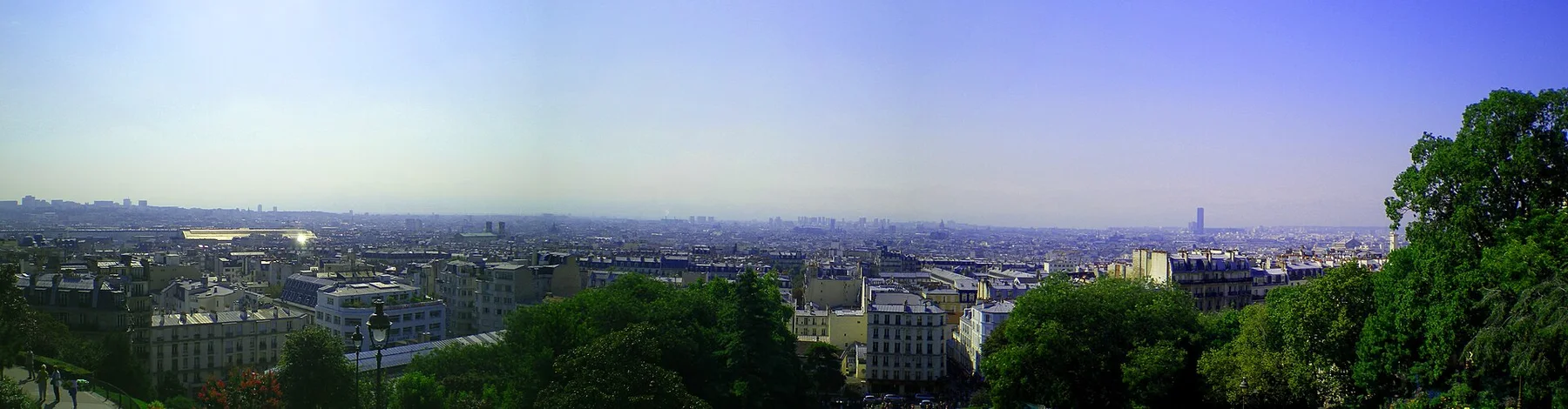
The white domes behind you were not built to be beautiful. That is the first thing worth knowing as you stand here, with the city of Paris spread out at your feet in every direction. Sacré-Cœur was conceived as a monument of public grief, a physical acknowledgment that France had failed, raised on this hilltop so it could be seen from everywhere and would be impossible to ignore. The stone is travertine, a limestone that actually bleaches itself whiter in rain, which is why the basilica glows even on grey mornings. Turn and look at the facade: those rounded arches and clustered domes belong to no Parisian tradition, nothing like the Gothic spires of Notre-Dame or the classical columns of the Panthéon. This building was designed to stand apart, deliberately foreign in silhouette, a statement cut into the skyline rather than fitted into it. What it was saying, and who it was saying it to, is a story worth understanding before you go any further.
Canal Saint-Martin
Before you do anything else, listen. Under the traffic and voices, the canal has its own quiet register: water moving against stone, and above it, the dry sound of plane tree leaves shifting in the breeze. You are standing beside Canal Saint-Martin, a four-and-a-half kilometre channel that cuts through the eastern arrondissements with the unhurried confidence of a street that knows its own worth. Look along either bank and you will see the double row of plane trees, their trunks mottled silver and pale green, arching overhead in a loose, irregular canopy. In spring and summer the light comes through in patches, flickering on the water's surface, and in late afternoon the whole canal glows amber in a way that stops people mid-conversation. This is the part of Paris that does not perform for tourists, or at least, it did not used to. The canal has a strong identity of its own: industrial in origin, cinematic in mythology, and perpetually contested in the present.
Parc des Buttes-Chaumont
On the hill where you are standing, until the early 1860s, the smell reached you long before you arrived. This slope served as a municipal refuse dump, a knacker's yard where horse carcasses were rendered into glue and tallow, and a seeping depository for city sewage, and the bare white gypsum of the hillside baked in summer and threw everything back at anyone downwind. The engineer Jean-Charles Alphand, who would build this park, wrote that the site spread infectious emanations not only to the surrounding streets but, carried by the wind, over the entire city. That is the thing to hold in mind as you walk: every cliff you climb, every tree-shaded path, every glimmer of the lake below, is a deliberate act of transformation. Parc des Buttes-Chaumont opened on the first of April, 1867, the same day as the Paris Universal Exposition. It was built in just over three years. And it was designed from the start to serve the people who had been living next to the dump.
Temple de la Sibylle
Welcome to the Temple de la Sibylle. Listen for a moment to the water moving at the base of the island in front of you, and notice the cool breeze coming off the lake. Now look across, then higher, to where a small round structure with slender columns and a shallow dome sits at the very top of the cliff. The whole island has been closed to visitors for several years, fenced off and quiet, while the city plans how to stabilize the ground underneath. That actually turns out to be the right way to see it. Gabriel Davioud designed this folly to be admired from below, framed by cliff and water, like a stage set hanging in the sky. So stay here at the lake's edge for a while, and look up.
Père-Lachaise Cemetery
Welcome to Père-Lachaise. The first thing you notice is the quiet, but it is a strange kind of quiet, layered with footsteps on cobblestones, the rustle of plane trees overhead, and the occasional crow calling from a chestnut branch. You are standing in the largest cemetery within Paris itself, around forty-four hectares of hillside laid out like a small city for the dead. Look down the avenue ahead of you, paved with cobblestones, signposted, and lined with stone tombs the size of garden sheds. This is not a graveyard in the usual sense. It is a neighborhood, and roughly three million visitors arrive every year to walk its streets and read its stories.
Mur des Fédérés
The wall in front of you is almost too modest for what happened here. You are standing at the far southeast edge of Père-Lachaise, where a short stretch of plain stone runs along the cemetery's perimeter, weathered by Parisian rain for a century and a half. A single plaque reads, in French, To the dead of the Commune, twenty-first to twenty-eighth of May, eighteen seventy-one. Welcome to the Mur des Fédérés, the Communards' Wall. It is one of the most politically charged patches of ground in the city, a place where generations of working people have come to mourn and to remember. Take a moment to feel the quiet of this corner of the cemetery. Then look up at the stone, and let it tell you why.
Start this Journey
Download the Paris Audio Tour Guide Offline app to unlock the full audio guide, offline maps, and GPS navigation for this tour.