A southern sweep from the catacombs to the botanical gardens, taking in the Left Bank's universities, cemeteries, and the philosophers' cafés. Equal parts memento mori and Enlightenment monument.
Catacombs of Paris Montparnasse Cemetery Church of Saint-Germain-des-Prés Pont des Arts Luxembourg Palace Jardin du Luxembourg Panthéon Jardin des Plantes
Audio Preview
Introduction to Bones & Bookshelves
Route Overview
Stops on this Tour (14)
Catacombs of Paris
Welcome to the Catacombs of Paris. The first thing to register is not a fact but a feeling, the way the air turns cool and damp, carrying a faint smell of wet stone and earth, while the noise of the street falls away completely behind you. You have descended a tight spiral stair, sinking some twenty meters below the pavement, into a silence that feels older than the city overhead. And then there is the number that gives this place its weight. The remains of roughly six million people rest in the galleries ahead of you, more human beings than live in most great cities. Take a moment here before the bones begin, because what waits is not really a museum so much as an honest confrontation with that scale.
Montparnasse Cemetery
You have just stepped off a busy Paris boulevard into one of the quietest squares of green on the Left Bank. Montparnasse Cemetery is not a place of sorrow so much as a place of company, because the people resting here spent their lives arguing, writing, painting, and provoking. Look down the broad central avenue and you are looking at a kind of address book of modern French thought, with philosophers and poets lying a few steps from singers and sculptors. The walls keep out the traffic, the trees soften the light, and within a minute the city seems very far away. This is the part of our walk where the bookshelves of Paris come to rest, where the names on the spines become names on the stones. Take a moment before you wander, and notice how ordinary the place feels, a working cemetery where Parisians still bury their dead, and yet how many of those dead changed the way the world reads and thinks.
Paris Observatory
You are standing in front of one of the strangest buildings in Paris, a place built not to be looked at but to look outward, upward, and across the whole surface of the Earth. Face the long pale facade and notice how plain it is, broad walls of cut stone with almost no decoration, as if ornament would only get in the way of the work. The four sides of this building are turned to face exactly north, south, east, and west, and an invisible line runs straight through its center from pole to pole. For more than two hundred years, that line was the one from which France measured the entire world. Now look down at the pavement near your feet. Set into the stone along this line, you can sometimes find a small bronze disk, about the size of your palm, stamped with a single name and the letters N and S. Those small markers trace the line beneath you, and almost everything that happened in this building was a long conversation between this stone and the stars above it.
Jardin du Luxembourg
Welcome to the Jardin du Luxembourg, the garden Parisians simply call le Luco, and the one they would defend before almost any other. Listen for a moment to the sound underfoot, that steady crunch of pale gravel that every path here is made of. Ahead of you sits a wide octagonal pond with a jet of water at its center, and scattered all around it are green metal chairs, dozens of them, none of them bolted down. This was built as the private garden of a queen, and somehow it became the shared living room of a republic. That contradiction is the whole story of this place, so before you go anywhere, just find a chair, drag it wherever you like, and sit. From here you can already see most of what makes this garden extraordinary, and it rewards you for slowing down.
Luxembourg Palace
A twelve-year-old girl leans out of a window in the Pitti Palace in Florence, palms flat against sun-warmed stone. She does not know it yet, but she will spend the rest of her life chasing that exact feeling. That girl grew up to be Marie de Médicis, and decades later, widowed and newly powerful, she decided to rebuild it here in Paris. Stand at the edge of the garden and look toward the pale stone facade rising above the trees. That is Luxembourg Palace, and she never actually called it that. She named it the Palais Médicis, after herself, and after her husband Henri IV was assassinated in 1610, she decided the cold stone corridors of the Louvre would never feel like home again. Look at the windows facing you now. Everything this stop has to tell you starts with one simple fact, this building was born out of longing.
La Sorbonne
Look up. If you are on Place de la Sorbonne, you will spot a dome rising just above the rooftops. That dome is the reason this stop exists. If you are on Rue des Écoles instead, facing the long stone frontage of the university, the dome is just around the corner. Either way, you are standing in front of an institution that has watched over more arguments than almost any other patch of stone in Paris. That dome was never meant to crown a museum or a palace, and for seven centuries this address has been where France decided which ideas were allowed to be spoken out loud. A theology college for twenty poor students grew into an institution the crown depended on, the church controlled, and the students eventually turned against both. This is not a museum piece, and it is a working argument that has never quite finished.
Panthéon
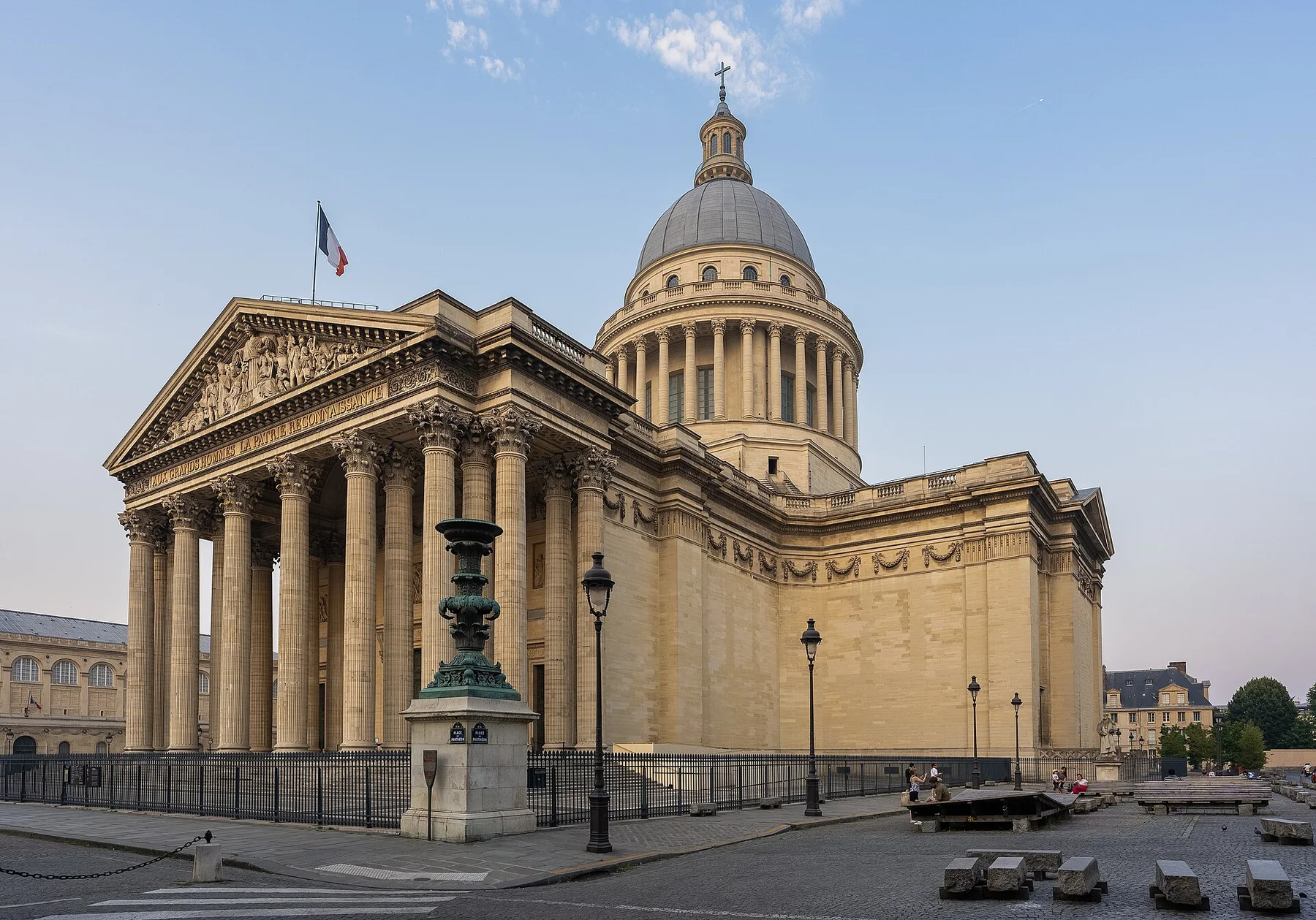
Look up at the pediment above the columns, the triangular slab of stone stretched across the top of this building, and read the words carved into it. Aux grands hommes, la patrie reconnaissante. To the great men, from a grateful nation. Notice what is missing from that sentence, because absence is often the most honest way into a story. This building spent more than three decades under construction as a church meant to hold the bones of a fifth century shepherdess, and was declared something else entirely before it was ever consecrated for worship. Underneath that dome sits the closest thing France has to a national conscience, a shifting, argued over answer to the question of who gets remembered. Stand here for a moment before you go in. What you are about to walk into has changed its purpose more times than almost any building in Paris, and every one of those changes left a mark you can still see.
Church of Saint-Étienne-du-Mont
Stand for a moment just inside the doorway and let your eyes adjust. Notice how the noise of the street falls away the moment the door swings shut behind you, leaving only a cool, stone quiet. What stops most visitors mid-step is the carved stone bridge arcing overhead, dividing the choir from the rest of the church. That is the last rood screen left standing anywhere in Paris. Most of the great churches that once had one took theirs down centuries ago, judged too cluttered, too medieval, too much in the way of the altar. Saint-Étienne-du-Mont kept its screen, and that single decision tells you almost everything about this place, a church that holds on to what others discard. Two slender staircases curl up its sides, more delicate than anything you would expect from stone. Before you move further in, take in that screen.
Church of Saint-Germain-des-Prés
Stand still a moment and look up at the squat, fortress-like tower rising just ahead of you. Its base has held weight over this stretch of the Left Bank since before the year 1000, older than the university across the river and older than almost anything else you will see on this walk today. This is the Church of Saint-Germain-des-Prés, and it carries a claim that sounds too large to be true at first. It is the oldest church still standing in Paris. Look closely at the thickness of the tower's walls and the small, deep set windows near its base. They were not built for looks, they were built for defense, in an age when this riverside meadow was raided again and again. Everything about this place, from its scarred stone to its long list of buried kings and philosophers, tells the story of how a monastery on the edge of the city became one of the most fought over, most rebuilt corners of it. Start with the tower in front of you. Everything else at this stop follows from it.
Café de Flore
Put your hand flat on one of the marble tables here and you will feel something that most Paris cafes cannot offer: a genuine chill, even in August. Café de Flore sits on the corner of Boulevard Saint Germain and Rue Saint Benoît, and for over a century that corner has doubled as a kind of unofficial faculty lounge for people who wanted to think in public. Look up, above the entrance, at the shining green and gold lettering that has barely changed in decades. This is not a restored replica built for tourists. It is a working cafe that happens to have hosted some of the most consequential thinking of the twentieth century at ordinary tables, over ordinary cups of coffee. What sets Flore apart from almost anywhere else on this tour is that its story is not about kings or saints. It is about the particular kind of stubbornness required to write a difficult book while sitting in a public room, surrounded by strangers, for months at a time. That is the thread running through everything at this stop, and it starts with a name borrowed from a goddess most visitors walk past without noticing.
Les Deux Magots
Look up at the central pillar, where two carved wooden figures lean out over the room, robes folded, eyes fixed on the tables below. This is Les Deux Magots, and those two figures gave the cafe its name. They have watched over this room since before it poured its first cup of coffee. Stand near the terrace on Place Saint-Germain-des-Pres and you are standing where French thought once had a working address, where philosophers argued and novelists borrowed a warm table. The room in front of you looks calm now, red banquettes, brass rails, the low hum of espresso machines. It was not always this quiet. What began here started with silk, not coffee.
Pont des Arts
Stand at the entrance of this footbridge and listen for a moment before you look. Underneath you the Seine moves against the stone piers with a low, steady sound, and somewhere behind you a scooter or a barge horn will likely cut through it. This is the Pont des Arts, and for over two centuries it has done something unusual for a Paris bridge: it has never simply carried people from one bank to the other. It has invited them to stop, to lean on the railing, and to make some kind of statement about themselves, from painters setting up easels to travelers who once found no better way to prove their affection than by locking it to the balustrade and throwing the key into the river below. That impulse, and the argument it eventually caused about what counts as permanent and what counts as clutter, is the real subject of this stop. At one end of this bridge sits a domed building, the Institut de France, and at the other end sits the Louvre. Everything the bridge has meant, historically, artistically, and romantically, unfolds in the short walk between them.
Musée de Cluny
Face the Musée de Cluny and look first at the meeting of its oldest stones. The Roman masonry is broad, heavy, and built for a monumental bath complex, while the later Gothic residence rises above it with narrower openings and finer carved details. Run your eyes along that change in texture before looking at the building as a whole. You are standing at a site where a Roman bath, a late medieval residence, and a museum of medieval art occupy the same ground. Inside, one of the museum's greatest treasures is the mysterious Lady and the Unicorn tapestry cycle. The Cluny begins with this physical fact, one age of the city was not cleared away before the next arrived, it was built into.
Jardin des Plantes
Listen first to the gravel under your feet, the birds in the trees, and the soft interruption of leaves overhead. Now look along the straight paths, clipped borders, and labeled beds, where living things have been separated into carefully defined groups. There is something almost like a filing cabinet hidden inside this very pleasant garden. For centuries, people have come here to collect nature, name it, classify it, teach from it, and sometimes try to control it. The calm of the place disguises an extraordinarily ambitious idea. At the Jardin des Plantes, the Enlightenment habit of organizing the natural world became something you could physically walk through.
Start this Journey
Download the Paris Audio Tour Guide Offline app to unlock the full audio guide, offline maps, and GPS navigation for this tour.