A full day on foot through the city's oldest core, tracing the arc from medieval Île de la Cité to the revolutionary east. Gothic stained glass, a royal prison, the great cathedral, then the tangled streets of the Marais and the square where the Bastille once stood.
Sainte-Chapelle Conciergerie Notre-Dame Cathedral Square du Vert-Galant Pont Neuf Place Georges Pompidou Carnavalet Museum Le Marais Place des Vosges Place de la Bastille
Audio Preview
Introduction to Cradle & Quarter
Route Overview
Stops on this Tour (11)
Square du Vert-Galant
You're standing at the level of the Seine itself, as close to the river's surface as you can get while still standing on solid ground in Paris. The stone steps you just walked down from Pont Neuf brought you below the level of the street, below the level of the bridge, and below much of what the city built on top of itself over two thousand years. The garden you're entering now occupies the westernmost tip of the Île de la Cité, the teardrop-shaped island in the middle of the Seine from which Paris grew. From here, the river parts around you on both sides, and the city fans out in every direction. This is the prow of Paris, and the sensation of standing on it, with water moving on your left and right and the willows trailing into the current, is one of those things Paris offers quietly, with no fanfare.
Pont Neuf
The stone under your feet is older than most of the buildings you passed to get here. Feel it underfoot for a moment. The name of the bridge you are standing on means New Bridge, and that has been quietly absurd for a very long time, because this is the oldest standing bridge in the city. The bridge was formally inaugurated by Henri the Fourth in sixteen-oh-seven, and it has been watching Paris change from this exact spot ever since. Below you, two arms of the Seine flow on either side of the island, the bridge spanning both channels at once. Stand at the mid-span and look in either direction. The smell of the river reaches you before anything else does, and the sound of water moving against stone has been constant here for four hundred years.
Sainte-Chapelle
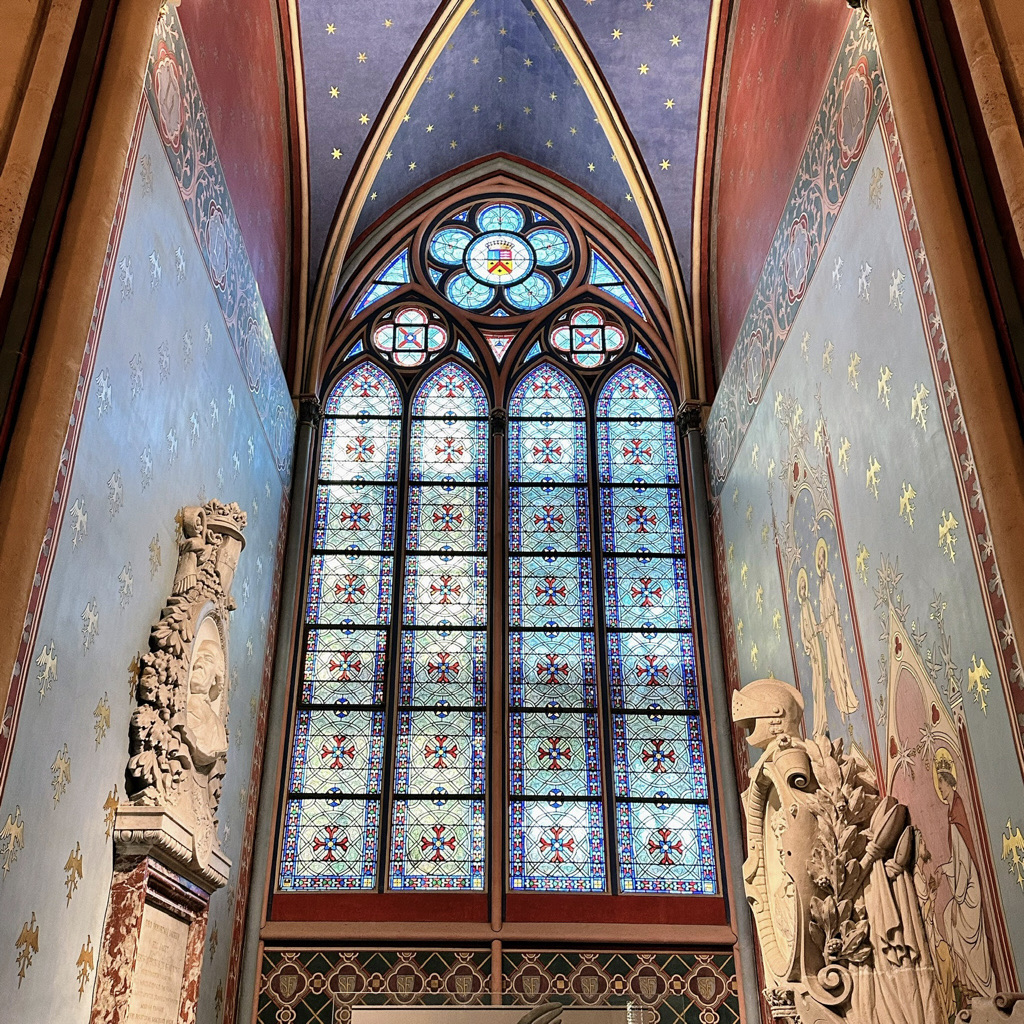
The first thing that happens when you step inside the upper level of Sainte-Chapelle is that your eyes stop working the way they normally do. You have just come from the brightness of a Paris afternoon, and suddenly every surface in front of you is radiating intense color, like standing inside a giant jewel. Most visitors stop dead in the doorway as the room seems to vibrate with light. Fifteen windows, each one nearly fifteen meters tall, transform what should be a stone building into something closer to a glass lantern. You are not looking at walls decorated with glass. In this space, the glass effectively is the wall.
Conciergerie
The towers you see from the Seine are misleading. They look like something from a fairy tale, round and capped and almost playful. That first impression is false. What lies behind them is one of the darkest chapters in French history. This was a royal palace before it was a prison, and a prison before it became the monument you are standing in now. The river-facing facade has barely changed in six centuries. Look at the three towers along the waterfront: the one furthest left, the Tour de l'Horloge, holds the oldest public clock in Paris still in its original location, first placed here in the 1370s. For thousands of people in the 1790s, the Conciergerie was the last place they would ever know.
Notre-Dame Cathedral
You are standing on the parvis of Notre-Dame de Paris, the great open square that faces the cathedral's western facade. Beneath your feet the cobbles slope gently toward the doors, worn smooth by millions of visitors over centuries. Before anything else, stop and look up. Stone towers rise nearly seventy meters above the ground, and three deeply carved portals span the full width of the facade in front of you. The stone you are looking at carries the work of dozens of generations, from 12th-century masons laying the first courses of limestone to the woodcarvers and glaziers who worked here until just recently. What you are about to walk into is not a single act of architecture but eight centuries of decisions, each generation adding to, correcting, or arguing with what the one before it had done. Stand here for a moment before you move closer. The closer you get to the facade, the more it will start to speak.
Hôtel de Ville
Look up at the flag flying from the roofline. Every stone of the building beneath it is a reconstruction. It was burned to the ground deliberately, and the people who burned it were French. The square in front of you has been a place of execution, revolution, liberation, and celebration, sometimes within living memory of each other. This address has always been where Paris decides what it is, who governs it, and in whose name. Welcome to the Hôtel de Ville, the city hall of Paris, and one of the most contested pieces of ground in the city.
Rue des Rosiers
The falafel hits you before the street does. That warm, spiced smell rises from L'As du Fallafel at number 34 and carries down the full length of Rue des Rosiers before you even see the sign. The street itself is narrow enough that you could almost reach across it: Hebrew lettering above the shop fronts, a bakery window with braided challah stacked behind glass, and at the far end a slight bend in the lane, as if the street has always kept something in reserve. Take a moment with all of it before the history arrives. The history will arrive.
Carnavalet Museum
The carriage gate swings shut behind you with a heavy wooden thud, and the noise of the Marais street falls away almost immediately, replaced by the dry crunch of footsteps on the inner courtyard's cobblestones. You're entering the Carnavalet Museum, and unlike most great museums in this city, it costs nothing to be here. The permanent collection is free. What you'll find inside isn't a curated highlight reel of famous paintings. It's Paris itself: the keys, the furniture, the fears, the letters, the boats. The museum sprawls across two interconnected aristocratic townhouses, and by the time you leave, you'll have moved through more than six thousand years of one city's existence, from Neolithic riverside settlers to the Paris of the last century, without ever once leaving its streets.
Place des Vosges
Stand anywhere in this square and something happens. The noise of the city simply stops. Not because the streets are far away, they are not, but because thirty-six pavilions of brick and pale stone form a perfect enclosure, and the geometry itself seems to absorb the chaos outside. You are standing in the Place des Vosges, the oldest planned square in Paris, and also the most intact. The pavilions and arcades surrounding you are essentially what Henri IV ordered built four centuries ago. The chestnut trees and the landscaped garden at the center came much later, a nineteenth-century addition to what was originally a bare sandy parade ground. Take a moment before moving anywhere. This place rewards stillness.
Place de la Bastille
The square you are standing in right now does not look like a birthplace. It is wide, noisy, and ringed with the kind of traffic that Paris seems to generate purely as a civic art form. But under the paving stones, under the boulevard, under the rumble of the Métro, this ground was soaked in a single afternoon in 1789 that changed how a civilization thought about power. The Bastille fortress stood where you are now standing. Eight towers, walls three meters thick, a moat, and a flag of the king. On a July afternoon, a crowd tore it down with their hands. Welcome to Place de la Bastille, which is not quite the place it is remembered as being, and which is all the more extraordinary for that.
Start this Journey
Download the Paris Audio Tour Guide Offline app to unlock the full audio guide, offline maps, and GPS navigation for this tour.