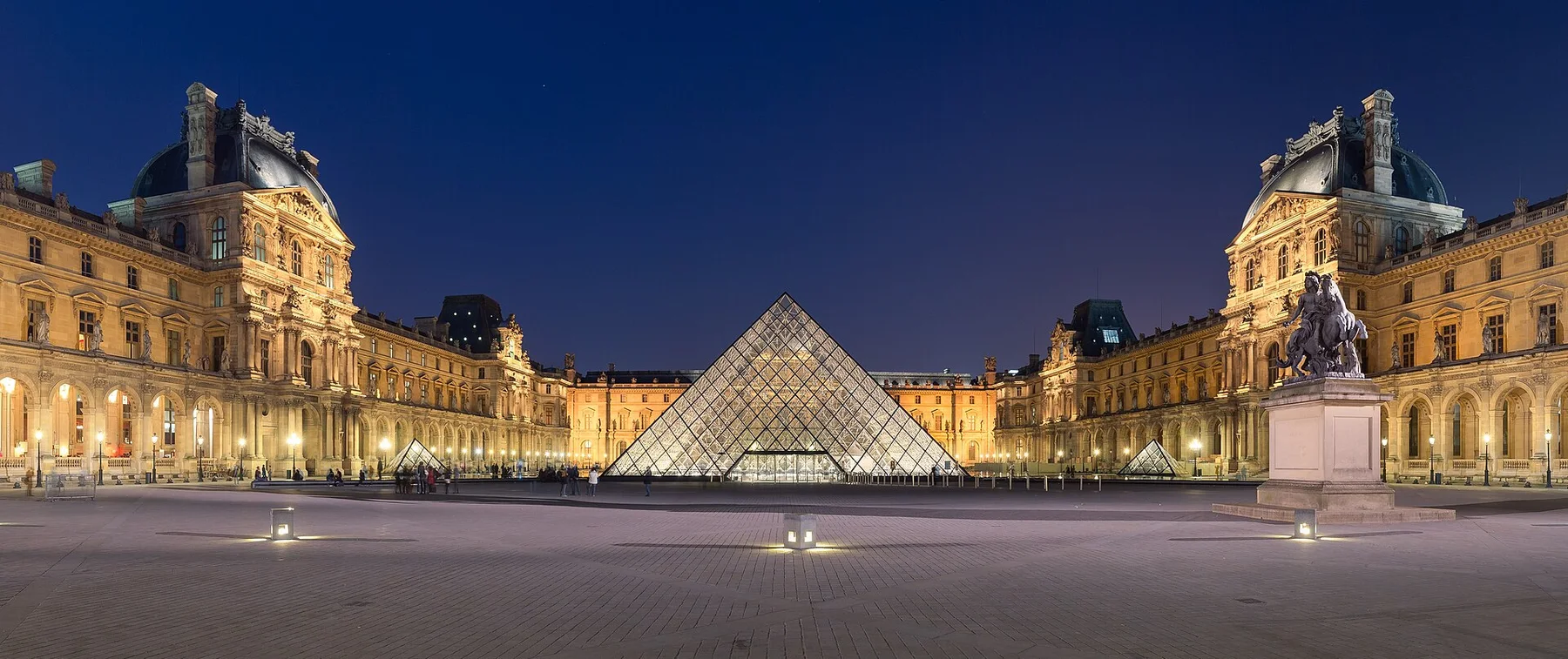
Louvre & Legend
One palace, three wings, and the masterpieces you cannot leave without seeing.
The Louvre is too large to see in a day, so this route does the choosing for you. Starting under the pyramid, it threads the Sully, Denon, and Richelieu wings in one unbroken loop, pausing at the building's own history and at the dozen works most visitors come to find. Expect roughly two to three hours at an unhurried pace, with the busiest rooms timed early. The medieval moat Venus de Milo Mona Lisa and The Wedding Feast at Cana French Romantic masterpieces Code of Hammurabi Napoléon III Apartments
Audio Preview
Introduction to Louvre & Legend
Route Overview
Stops on this Tour (14)
Under the Pyramid – Hall Napoléon
You are standing at the exact centre of one of the largest museums on earth, and it is a detail most of us hurry straight past. Right here, beneath your feet, is where the whole institution breathes. The Hall Napoléon opened in 1989 as the Louvre's new front door, a subterranean reception space dug from the deep alluvial ground beneath the Cour Napoléon, giving the museum its first real entrance hall in nearly two centuries of public life. Notice the stone underfoot, cool and slightly smooth, and the way the sound in here is different from the street, voices rising and then falling back to you softened, as if the ceiling has filtered them. This is the crossroads. Everything that happens to you in the next few hours begins here.
Winged Victory of Samothrace
As you reach the top of the stairs, look up. High above the landing stands the Winged Victory of Samothrace. Greek sculptors carved her from white marble more than two thousand years ago, and the people who set her here wanted you to arrive exactly like this, a little out of breath and looking upward. She has no head and no arms, and somehow that takes nothing away from her. Her body leans into a wind you cannot feel, her great wings sweep back, and the thin fabric across her stomach looks soaked through and pressed to the skin. Notice how she seems caught in a single instant, the moment she lands on the front of a ship. Of all the famous things in this building, she may be the one that needs the least explaining and rewards the most looking.
Galerie d'Apollon
Welcome to the Galerie d'Apollon. The first thing to do here is simple. Look up. The whole ceiling above you is a torrent of gold and painted sky, built so that a king could stand beneath it and call himself the sun. This was the first grand royal gallery the French crown ever raised inside the Louvre, and it became, two centuries after it was begun, the home of what survives of the French crown jewels. Hold both of those facts in your head as you stand here, because this is a room about glory, and about what happens to glory once the people who built it are gone.
Empire and Revolution in Large Format
You have just walked into the part of the Louvre where French painting decided to think big. Stand still for a second before you chase any single canvas, because the first thing to take in is the room itself, the deep red walls, the high ceiling, the soft even light pouring down to make old oil glow. This is the Salle Mollien, and the walls around you hold some of the largest paintings French artists ever made. The one that should pull your eye first is straight ahead, a raft crammed with bodies under a stormy sky. Nearby hangs a woman striding forward with a flag, and through the galleries to your right, in the next great room, waits an emperor being crowned. Each one took a real event, an empire, a shipwreck, a revolution, and blew it up to the size of a wall.
Mona Lisa
You are standing in the Salle des États, in front of the most looked-at painting on earth. Take a moment before the crowd presses in, and register what you actually see: a panel of wood, about 77 by 53 centimetres, roughly the size of a small kitchen cupboard door, showing a woman seated in front of a wild and dreamlike landscape. That is all. It is smaller than you expected, darker than the reproductions, and separated from you by a thickness of climate-controlled bulletproof glass. The room around it is enormous, the crowd surges and eddies, phones rise in the air like a tide. And yet, if you can hold your focus for a few seconds, something reaches across the distance. There is a presence here that the photographs, for all their billions of copies, have never quite managed to capture.
The Wedding Feast at Cana
Welcome to the strangest crowd dynamic in the entire Louvre. You are standing in the room the Louvre calls the Salle des Etats, and almost everyone around you is facing one wall, phones raised, packed shoulder to shoulder to glimpse a small portrait behind glass. Now turn your back on them and look up at the wall behind you, because the painting you are about to ignore is the largest canvas in the whole museum. This is The Wedding Feast at Cana, nearly seven metres high and ten metres wide, a wall of silver, silk, and music that hundreds of people stand in front of every hour without ever turning around. The room has quietly organised itself so that its biggest picture is the one nobody photographs. For the next few minutes, be the person who looks the other way.
The Grande Galerie
Look straight down the corridor ahead of you, until the walls seem to pinch together in the far distance. That is the Grande Galerie, the longest room in the whole Louvre, running for hundreds of metres along the bank of the river Seine. You are standing at its mouth, in a smaller room called the Salon Carre, which opens straight into it. Between this spot and that distant wall lie three centuries of Italian painting, from flat medieval gold to the dark drama of the Baroque. Most visitors pour down the gallery with their eyes fixed on one small portrait far ahead, missing almost everything else. You are going to do the opposite and take it slowly. Begin with the corridor itself, because the room is as much a part of the story as anything hanging in it.
Venus de Milo
At the far end of this gallery, between two deep red marble columns, a woman carved in white marble stands a little taller than anyone around her. The warm tone of the stone seems to push her paleness forward, so your eye finds her before you have taken a step. And the first thing you notice is what is missing: she has no arms. Welcome to the Venus de Milo, one of the most famous sculptures on earth. Notice the smooth break of her shoulders and the empty air where her hands should be, because that absence is the whole reason the crowd has gathered here. For two hundred years this broken figure has held her ground, and the missing arms are a large part of why. Let the eye settle on her before we go any further.
The Seated Scribe and Egyptian Antiquities
Somewhere in front of you, a man who has been dead for forty five centuries is looking back. Find him in his glass case, a small painted limestone figure seated cross legged, barely fifty four centimetres tall, a papyrus scroll open across his lap. Welcome to the Egyptian galleries, and to one of the most lifelike faces to survive from the ancient world. The first thing to do is meet his eyes, because they are the reason people stop here and forget to keep walking. They are made of rock crystal and pale stone and a rim of copper, and they catch the light so well that they seem wet, alert, about to blink. He is not a king and not a god, just a clerk, and yet here he is, holding your gaze. Stand with him for a moment before you learn anything else, because the strangeness of being looked back at by someone this old is the whole point of this stop.
The Medieval Louvre
You are standing, right now, at the bottom of an eight-hundred-year-old ditch. What surrounds you are not gallery walls. They are the surviving foundations of a military fortress that once sat at the western edge of a medieval city small enough to walk across in under an hour. The original stonework here was quarried and laid around the year 1190, before a single painting hung anywhere in this building. Most visitors upstairs never come down here. That is their loss, and your good fortune.
Code of Hammurabi and Near Eastern Antiquities
The tall, dark stone in front of you holds one of the oldest written records of law that survives anywhere in the world. Take it slowly, and let your eyes climb it. It rises to about the height of a person and a half, polished and finger shaped, its lower body packed with tight columns of wedge marks and a small carved scene crowning the top. It was created under Hammurabi, the king who welded the city of Babylon into an empire, around the middle of the eighteenth century before our era. Begin with the stone itself, its colour and its scale, because almost four thousand years of argument about justice starts right here, on a surface you could nearly reach out and touch.
Cour Marly and Cour Puget
Welcome to the Cour Marly, where the first thing to do is simply look up. Daylight pours through a roof of glass and slender steel onto an army of white marble figures, and high on the topmost terrace two stone horses rear against the light, wrestled by men who seem about to lose the fight. These are sculptures built for gardens and open squares, made to stand in wind and weather, yet here they are indoors, lit like a stage. Listen for a moment and you will notice the hush, footsteps and voices softened and lifted up into the glass, a quiet you never get among the painting crowds. Almost everything in this court is a survivor of some kind, rescued from a vanished royal world, and the horses on that high terrace are where the story begins. Let your eye climb toward them, because the court carries their name.
The Medieval Treasury
Find the dark red, bird-shaped vessel in the Suger display. Around it, the glass cases of these adjoining Richelieu galleries hold ivory, copper, crystal, and gold, all packed into objects small enough to miss. This is the Medieval Treasury, and its central story is survival through reuse. The bird's stone body is ancient. Its metal head and wings are medieval. Its museum life began after the French Revolution.
Napoléon III Apartments
You have reached the rooms called the Napoléon III Apartments, and the first thing to take in is the collision of crimson and gold beneath the immense crystal chandelier. These rooms look imperial because almost every surface was designed to project rank. Yet the emperor never lived here. They were the official apartments of his Minister of State, preserved almost intact so that the rooms themselves, not any single object, are the work you have come to see.
Start this Journey
Download the Paris Audio Tour Guide Offline app to unlock the full audio guide, offline maps, and GPS navigation for this tour.