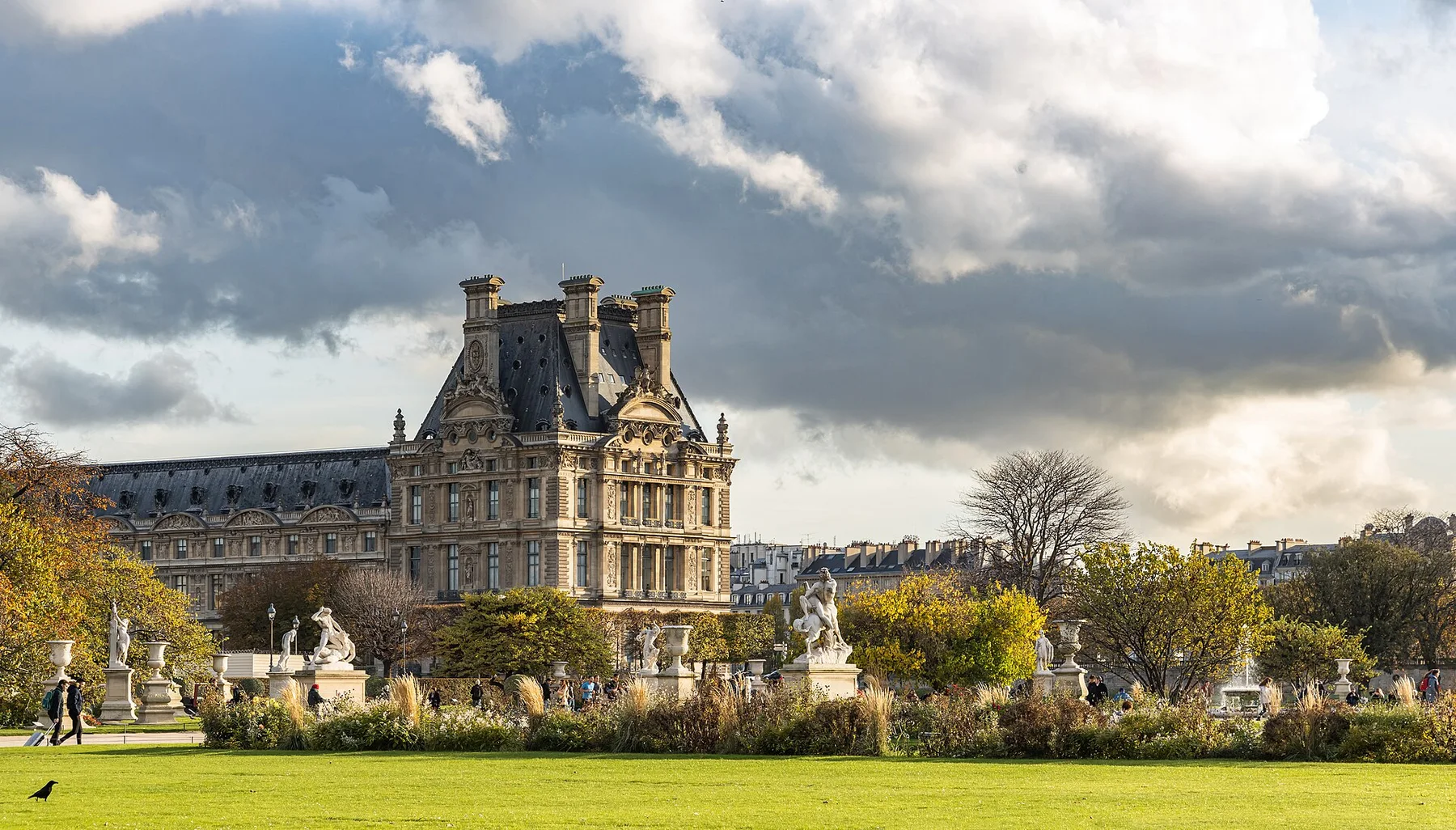
The cultural spine of France in a single day. Start with the Impressionists, walk east through the formal gardens to the palace of the kings, then north to the opera house and the great department store rooftop.
Musée d'Orsay Musée de l'Orangerie Tuileries Garden Louvre Pyramid Louvre Museum Palais-Royal (Domaine National) Palais Garnier (Opéra) Galeries Lafayette Rooftop
Audio Preview
Introduction to Royal Heart
Route Overview
Stops on this Tour (8)
Musée d'Orsay
Stop just past the entrance, before the crowd carries you forward. Listen for a moment to the way the sound moves in here, voices and footsteps lifting into a vault that once echoed with arriving trains. The space above you is one hundred and thirty-eight meters long, glass and iron overhead, the curved bays decorated with great gilded rosettes. This used to be a railway station. Trains for Bordeaux and Toulouse arrived silently on electric power, the first urban terminal in the world built without steam, which is why the ceiling above you is gilded rather than blackened by soot. Upstairs a Van Gogh self-portrait is gazing out from his year in a Provençal asylum. The Musée d'Orsay is the strangest kind of resurrection. You are standing inside a building that almost did not survive.
Musée de l'Orangerie
Welcome to the Musée de l'Orangerie. From the outside this looks like a modest pavilion at the edge of the gardens, and that is part of its quiet trick. Pause for a moment inside the lobby, take a breath, and then make your way into the first of the two oval rooms. Eight long paintings curve around you on the walls, and the room seems to hold its breath. These are the Nymphéas, the Water Lilies, the late masterwork Claude Monet gave to France. The building itself is older than the paintings, but the rooms you are standing in were designed around them, on his terms, in his last years.
Place de la Concorde
You're standing in the largest open square in Paris, a vast deliberate emptiness laid out two and a half centuries ago to honor a king. Look first to the obelisk at the center, that ancient stone needle, and let your eyes circle slowly around it. To the east lie the green gardens of the Tuileries. South of that runs the silver line of the Seine. To the west, the long sweep of the Champs-Élysées climbs toward the Arc de Triomphe. And to the north, the columns of the Madeleine rise above the rooftops. This square was designed to be admired from every angle. And within twenty years of its completion, it would become the most notorious patch of ground in France.
Jardin des Tuileries
Listen to the gravel under your feet for a moment, because that crunch is the sound of four centuries of Parisians taking exactly this walk. You are standing in the oldest formal garden in the city, a long rectangle of clipped trees, stone basins, and dead straight alleys stretched between the river and the Rue de Rivoli. Find the widest path, the central alley, and stand right on it facing west, with the glass pyramid of the Louvre at your back, so the garden opens out in front of you toward the round basin. That dusty pale gravel will follow you the whole way, so forgive your shoes in advance. The name of this place sounds elegant, but it is pure industry. Tuileries means tile works, and before any queen or gardener arrived, this ground was a muddy district of kilns baking roof tiles from the clay along the Seine. From mud and smoke came the most disciplined green space in France, and that straight line under your feet is going to organize everything you hear at this stop.
Louvre Pyramid
Stand anywhere in this courtyard and your eye is pulled to the same place, a pyramid of glass rising from the cobbles like something set down overnight. Listen for a moment too, because beneath the crowd noise runs a constant low wash of water from the pools at its base, the soundtrack of this whole stop. Welcome to the Louvre Pyramid, the entrance that nearly tore Paris apart before it won the city over. The stone wings around you took centuries to build; the glass at their center took six years and caused more argument than almost all of them combined. Walk toward it and watch how it changes, silver in flat light, gold at sunset, almost ghostly when the sky turns grey. That shifting quality is the whole idea, a structure designed to be seen through rather than looked at. For the next few minutes, this triangle of glass and the courtyard around it are the entire story.
Palais-Royal
Right here, in one of the quietest corners of central Paris, you are standing in a place that has been, at various points in its history, a cardinal's private world, a royal nursery, an open-air casino, a revolutionary pamphlet market, and now a garden where ministry officials eat their lunch among tourists and pigeons. The long arcaded galleries enclosing this garden on three sides are what you want to look at first: pale stone arches running the full length of each wing, framing boutiques and the occasional restaurant at ground level. Above the arches, rows of apartment windows face inward. That combination of gallery, garden, and inhabited upper floors is the physical key to understanding everything that happened here. What makes Palais-Royal unusual is not any single thing you can point to, but the sheer density of transformations this one rectangle of Paris has absorbed. Each era left something behind, and some of those things are still visible if you know where to look.
Palais Garnier
Stand on the Place de l'Opera, with the traffic curling around the square behind you, and let your eye climb the front of this building. Listen for a moment too, to the hum of the cars, the scrape and echo of footsteps crossing the stone, the ordinary noise of a working square. Now start at the heavy stone arches at street level and rise all the way to the green dome and the gold figures that blaze at the roofline when the sun catches them. This is the Palais Garnier, and it was built to be looked at. Charles Garnier wanted a monument so theatrical that the spectacle would begin out here, in the open air, before anyone reached a seat. Notice how the facade is layered like a wedding cake, every surface carrying a column, a mask, a gilded figure, a flourish of carved stone. There is almost nowhere for the eye to rest, and that is exactly the point. For the next little while, treat this place as what it always wanted to be, a performance in stone.
Galeries Lafayette Rooftop
Welcome to the rooftop of Galeries Lafayette, one of the few places in Paris where the whole city opens up around you and nobody asks for a ticket. Most visitors spend their time seven floors below, threading between perfume counters and designer racks, never realizing that the best thing here is free and sits above their heads. Step toward the railing and notice how the air changes, the warm, scented hush of the shop floors giving way to a cooler, open breeze that smells of the city itself. Let your eyes travel across the grey zinc roofs that ripple toward the horizon in every direction. To the north a white silhouette crowns a hill, to the southwest a familiar iron spire catches the light, and the rest is a tight weave of chimneys and balconies. This terrace turns a temple of shopping into a public balcony over Paris, which is a quietly radical idea when you stop to think about it. The store wants you to look down at its goods, but up here the invitation is to look out instead.
Start this Journey
Download the Paris Audio Tour Guide Offline app to unlock the full audio guide, offline maps, and GPS navigation for this tour.