Half a day along the world's most recognized stretch of riverbank. Contemporary art warm-up, then the great viewpoint, then the tower itself — finish on the lawns at dusk for the hourly sparkle show.
Palais de Tokyo Musée d'Art Moderne de Paris Palais de Chaillot Jardins du Trocadéro Pont d'Iéna Eiffel Tower Champ de Mars
Audio Preview
Introduction to The Iron Lady
Route Overview
Stops on this Tour (8)
Palais de Tokyo
Welcome to the Palais de Tokyo. Look up at the long pale facade and follow the rhythm of stone and columns and deep openings and shadow across its surface. From outside everything feels measured and permanent. It has the bearing of a public institution built to last. Inside the contemporary art center in the west wing the experience changes sharply through exposed concrete and rough surfaces and enormous spaces that artists can repeatedly transform. That contrast is not an accident of neglect. It has become central to the identity of the place. The Palais de Tokyo is a building where permanence on the outside makes experimentation inside feel even more radical.
Musée d'Art Moderne de Paris
You have just walked into a museum that charged you nothing to see its permanent collection. That is the first surprise of the Musée d'Art Moderne de Paris. Around you is a city-owned collection of roughly fifteen thousand works, focused on the art of the twentieth and twenty-first centuries. Matisse, Dufy, Picasso, Modigliani, and many others appear here without a permanent collection admission fee between you and the art. As you enter, notice the generous scale of the galleries, because some of the museum's defining works are far too large to behave like ordinary framed paintings. This place matters because Paris did not merely become a center of modern art, it eventually decided that this art should belong to public life.
Palais de Chaillot
Welcome to Palais de Chaillot, where one of the cleverest architectural effects is the space the architects chose to open up. Start by looking at the two long wings, then at the empty space between them. In nineteen thirty-seven, the old central hall and towers were removed as the site was transformed for the international exposition. The new palace kept the great curving sweep on either side but opened the middle into a broad esplanade. Those wings now act like the sides of an enormous stage set, directing your eye through the center. Before you look through that frame, notice the frame itself, because that is the first trick Chaillot plays.
Place du Trocadéro
Stop walking for a second and look straight ahead. The Eiffel Tower should be almost dead center, held in an unusually wide frame of open sky. Around you, shoes scrape across the paving, phones rise into the air, and people keep shifting a few steps left or right in search of a cleaner photograph. Welcome to Place du Trocadéro, the elevated public square that has become Paris's great balcony facing the tower. What matters here is not simply the monument in the distance. It is the way this open ground turns looking itself into a public activity. Trocadéro is a stage whose main performance is the crowd seeing Paris, and being seen with it.
Jardins du Trocadéro
Welcome to Jardins du Trocadéro. If the fountains are running, you may hear them before you properly see them, a low rush spreading across the slope. Ahead, the long basin draws your eye downhill through terraces, lawns, sculpture, and moving water. From higher ground, the whole garden looks almost diagrammatic, ordered and symmetrical. Walk into it and that neat picture breaks apart into cool spray, wet stone, voices, footsteps, and flashes of gold. This is the garden's great trick: it turns a simple descent into something you physically enter.
Pont d'Iéna
Welcome to Pont d'Iéna. Before you look anywhere else, notice the stone beneath your feet, the low parapet beside you, and the Seine opening on both sides. This bridge carries a strange distinction: it was built to celebrate a military victory, then nearly destroyed because that victory was written into its name. Napoleon meant this crossing to make triumph permanent in the fabric of Paris. Below you, boat wakes loosen the reflections into silver and green fragments, while the five arches hold their steady rhythm across the water. Keep that tension in mind here, because Pont d'Iéna is less a frozen monument than a survivor of the politics carved into it.
Eiffel Tower
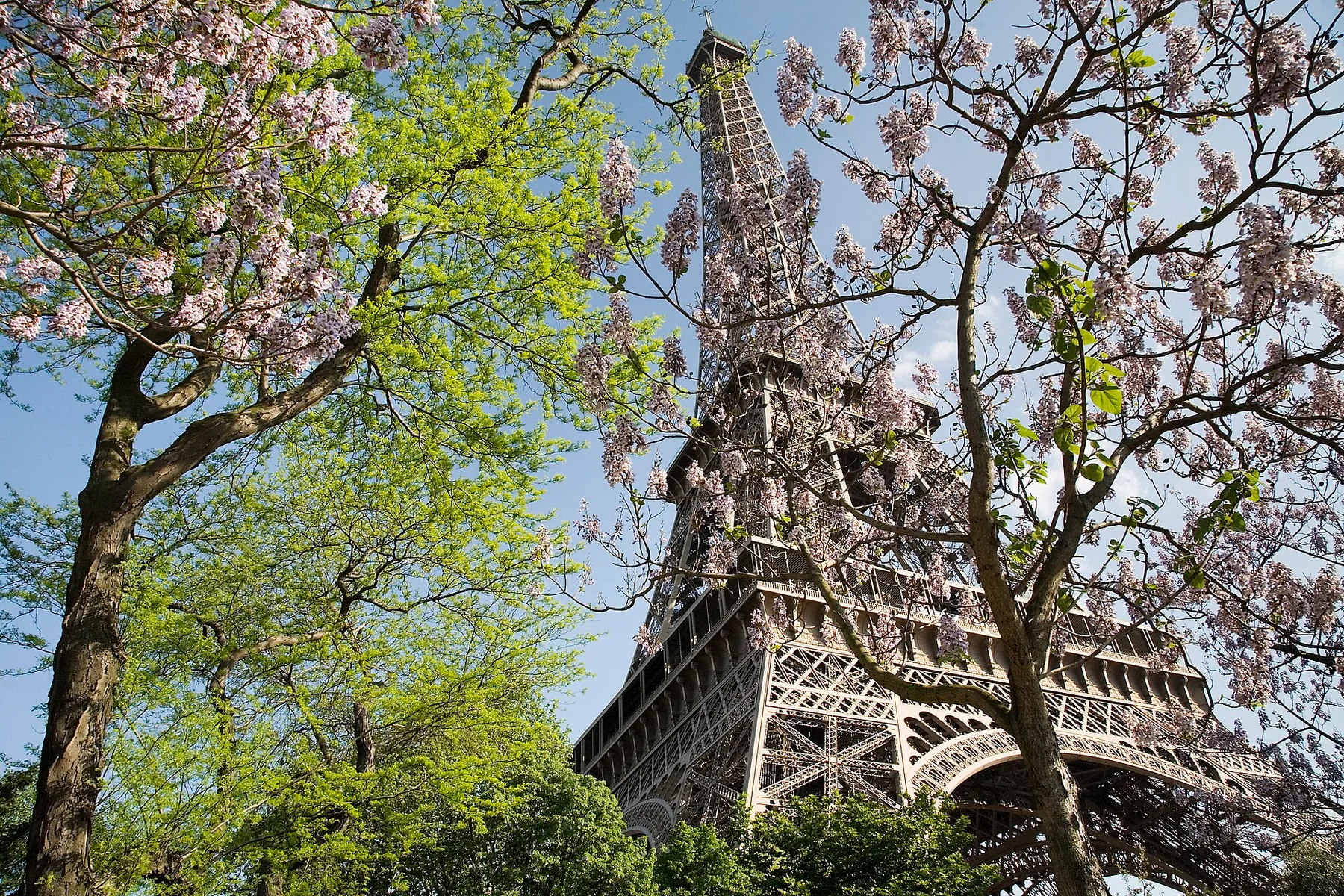
Stand beneath one of the great iron legs and look straight upward. From here, the Eiffel Tower almost stops looking like the neat silhouette you know from photographs. Rivets, diagonal braces, platforms, and open air pile above you. Higher up, the structure seems to dissolve into the sky. This immense machine of wrought iron was built for the Exposition Universelle of 1889 and was never meant to be permanent. The monument that became a symbol of France began as an argument over whether it should exist at all.
Champ de Mars
Welcome to the Champ de Mars. The Eiffel Tower may grab your eyes first, but for this stop, let them drop to the landscape beneath it. Notice the broad lawn, the pale gravel paths, and the long lines of trees stretching toward the École Militaire. This space began not as a pleasure garden, but as a field for soldiers to drill, march, and maneuver. Its name comes from the Campus Martius of ancient Rome, a field associated with Mars, the god of war. That military origin helps explain the extraordinary length and openness you can still feel today. A landscape made for disciplined ranks has become a place where people spread blankets, kick off their shoes, and sit wherever they please.
Start this Journey
Download the Paris Audio Tour Guide Offline app to unlock the full audio guide, offline maps, and GPS navigation for this tour.