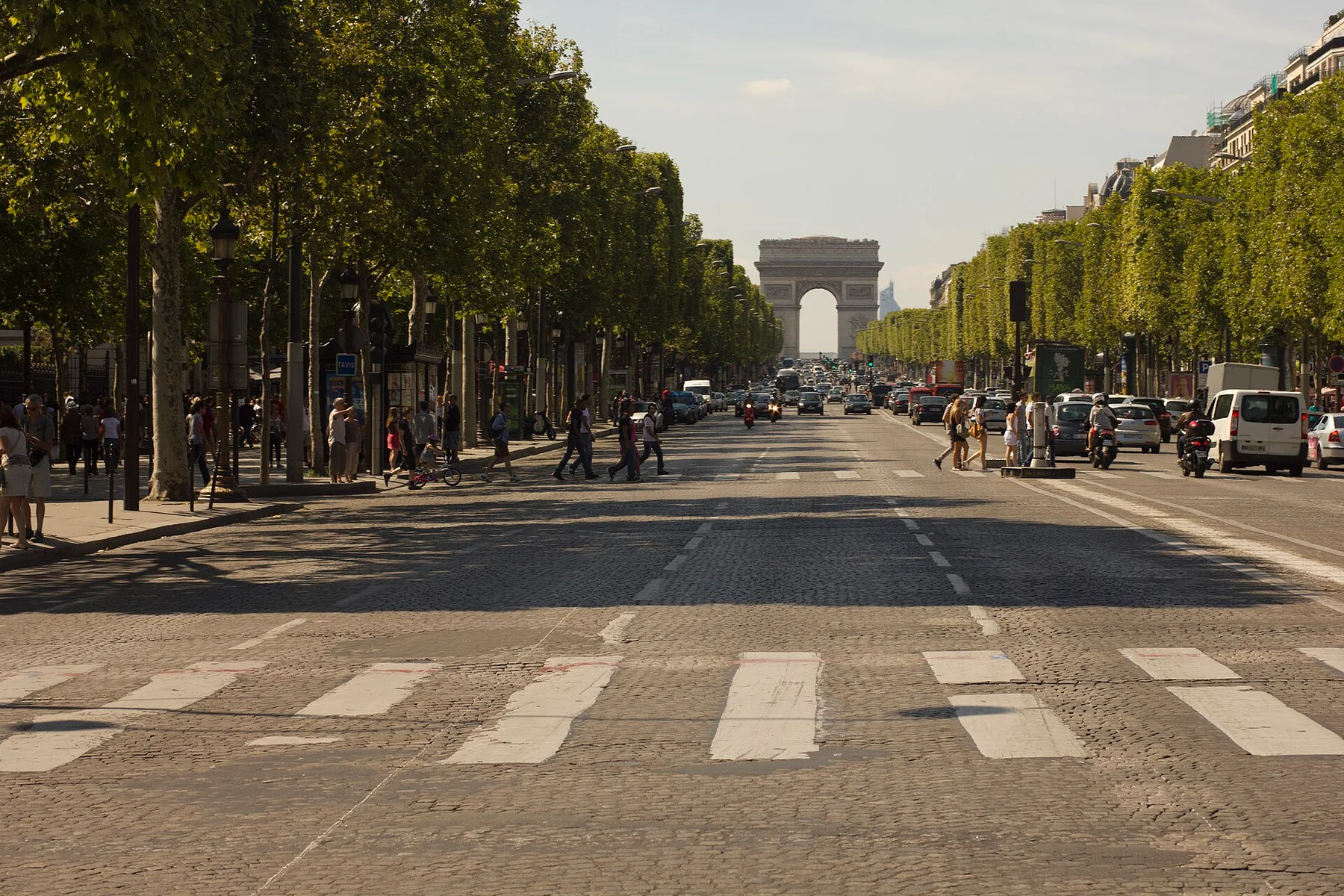
Concorde to Étoile along the grandest boulevard in Europe, with a southern dogleg across the Seine to Les Invalides and the emperor's tomb. Finish in the quiet English-style gardens of Parc Monceau.
Place de la Concorde Grand Palais Petit Palais Pont Alexandre III Hôtel des Invalides Musée de l'Armée Arc de Triomphe Parc Monceau
Audio Preview
Introduction to The Triumphal Way
Route Overview
Stops on this Tour (13)
Place de la Concorde
Welcome to Place de la Concorde. For a moment, listen to the traffic moving around the square. Beneath it, you may catch the splash of the fountains. Now look toward the tall stone obelisk at the center. This square began as a royal monument, became an execution ground, and was later renamed for reconciliation. Few places in Paris make political change feel so physically present beneath your feet.
Champs-Élysées — Lower Section
Listen first to the traffic, then to what the trees do to it. You have arrived on the lower Champs-Élysées, the part of the avenue where garden still has the upper hand over commerce. Look to either side of the roadway, where trunks, gravel paths, benches, and patches of shade break the monumental width into smaller rooms. After rain, the air can carry the dark smell of leaves and damp soil, while tyres hiss on the pavement beyond the branches. This is why the lower section matters: the grand avenue is still experienced here at walking speed. Keep that contrast in mind, straight road and soft garden, because almost every layer of this place grows from it.
Cours-la-Reine Riverfront
The river changes the scale of Paris here. Welcome to Cours-la-Reine Riverfront, where trees, stone, and moving water create a long horizontal view. Look along the promenade before looking inland. This is one of the oldest parks in Paris, created in 1616 beside the Seine. Its importance does not come from a single monument, but from the way people have moved through this narrow strip for more than four centuries. Here, the monumental city suddenly feels human in scale.
Pont Alexandre III
Gold flashes above the traffic, but the real genius of Pont Alexandre III is how little the bridge gets in the way. You are standing on one of Paris's most ornate crossings, yet its steel structure remains remarkably unobtrusive from the deck. Look first at the gilded figures rising above the four corners, then along the broad open crossing over the Seine. Sculpture, metalwork and engineering were all designed as one composition here. The result is a bridge that behaves almost like an outdoor stage.
Esplanade des Invalides
The first thing this lawn does is make you feel small. You are standing on the Esplanade des Invalides, a vast green approach laid out to make distance part of the experience. Face the long facade ahead and let your eye rise to the gilded dome behind it. From the river end, that same axis runs nearly half a kilometre across open ground. Before you notice any single detail, the sheer scale has already done its work.
Hôtel des Invalides
Stand for a moment in the Cour d'Honneur and listen to what the space does to sound. Footsteps strike the paving, then soften beneath two levels of stone arcades. This is the great central court of Hôtel des Invalides, 102 metres long and 64 metres wide, built at the heart of an institution created for soldiers who could no longer remain in active service. Look around the four enclosed sides first, rather than rushing through them. Above the southern roofline, the gilded dome provides the distant signal by which the whole complex is recognizable across the Paris skyline. Down here, though, the scale is human: galleries, doors and rooms gathered around a shared court.
Musée de l'Armée
Steel catches the gallery light before the labels do. You are inside the Musée de l'Armée, where centuries of French military history have been reduced to objects you can stand almost nose to glass with. Start with the nearest armour or weapon case and notice how quickly polished metal gives way, farther through the museum, to worn cloth and paper maps. The more revealing question here is not who won, but what kind of soldier each era built, dressed and asked to serve. That is what makes this collection matter: military power keeps returning to the scale of one body, one tool, one piece of material.
Dôme des Invalides
The first surprise inside the Dôme des Invalides is not above you. It is below. Look through the great circular opening in the floor, and Napoleon's red stone sarcophagus appears at the center of a vast, pale crypt. Before you descend a single step, the building has already arranged the encounter. You stand over the emperor, but the whole room directs your gaze toward him.
Grand Palais
The roof seems to arrive before the building does. Here beside the Grand Palais, lift your eyes above the long stone colonnade. See the pale green ribs and the immense sweep of glass. This is the building's central trick, a classical palace outside and a steel and glass exhibition machine within. It was raised for the World's Fair of nineteen hundred, with room for spectacles too large for an ordinary gallery. From the pavement, the roof is the first clue to what waits inside.
Palais de la Découverte
You are standing beside a pale stone facade on Avenue Franklin D. Roosevelt. Above the entrance, the name reads Palais de la Découverte, the Palace of Discovery. The word discovery mattered here from the beginning. This institution was built around experiments, questions, and human voices. From 1937 onward, visitors came to watch science happen in real time, with a working apparatus and a demonstrator before an audience.
Petit Palais
The first surprise at the Petit Palais is that the word little does almost no useful work. From the pavement, look toward the broad steps, the gilded entrance gate, and the dome rising above the central arch. Behind that ceremonial front is the fine arts museum of the City of Paris, whose permanent collection costs nothing to enter. Temporary exhibitions require a ticket. The scale says palace, but access to the permanent galleries is unusually open.
Arc de Triomphe
At the Arc de Triomphe, traffic circles like a fast moving moat, yet a small flame burns beneath the vast stone vault. You are standing beside a monument conceived for military glory and gradually transformed into a place of national remembrance. Look first through the enormous central opening, then lower your gaze toward the low grave beneath the center of the vault. The arch frames the sky, while the tomb draws your attention back to a single human life. That tension between triumph and loss is the key to everything here.
Parc Monceau
Parc Monceau begins with a deception: its ruins were never ancient. First, look for the curved colonnade beside the oval pool. Then let your eye search among the trees for the small stone pyramid. Neither is an archaeological discovery. Both belong to a garden designed to make reality feel briefly uncertain. That mixture of illusion, calm, and social display is the key to everything around you.
Start this Journey
Download the Paris Audio Tour Guide Offline app to unlock the full audio guide, offline maps, and GPS navigation for this tour.